
Why Aren’t You Listening?
Psilocybin and Animal Research: What We Learn When We Can’t Listen
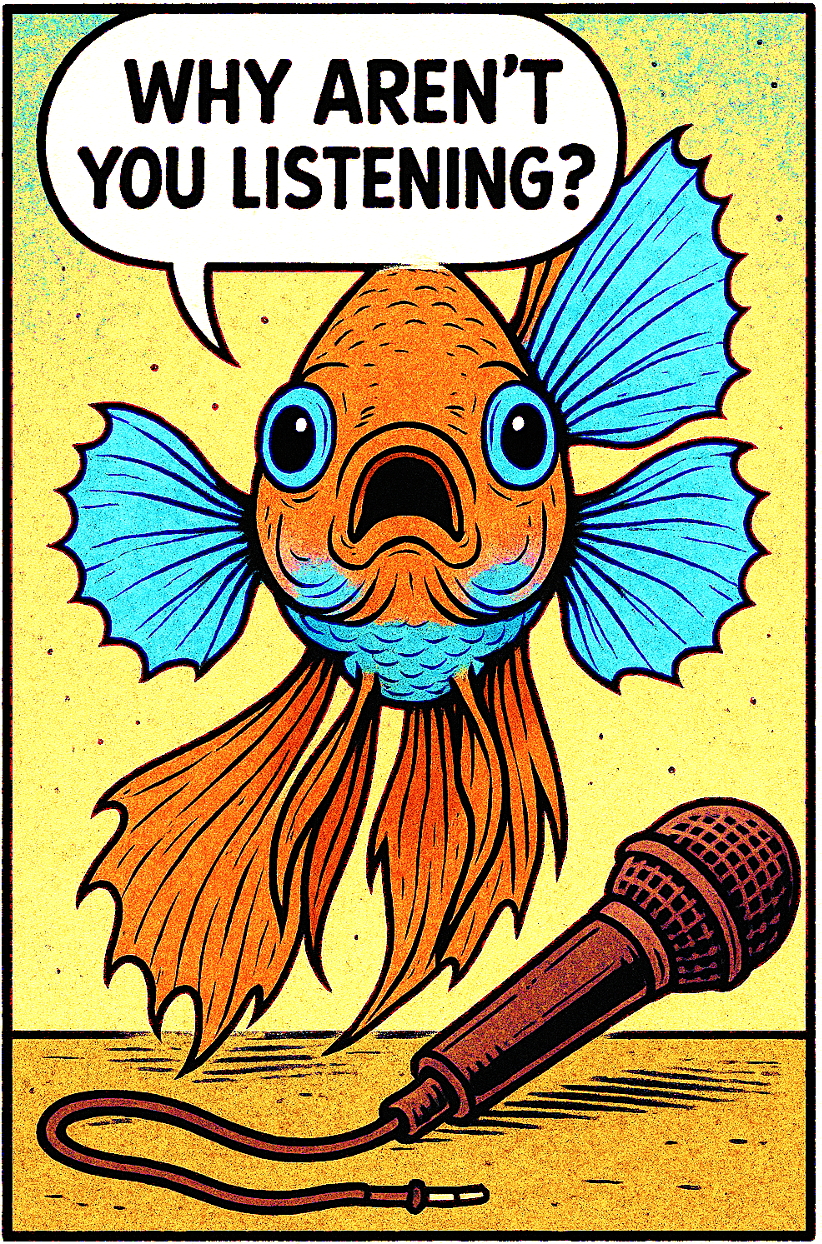
If you’ve seen the Her Magic Mushroom Memoir cover, you know it features a Siamese fighting fish and a mushroom. Now there’s a cartoon version of that fish staring into a disconnected microphone, shouting, “Why aren’t you listening?” What’s going on here?
Maybe the fish is asking something we should all ask ourselves. Because in truth, we can’t listen to fish—or to any non-human animals. We can only observe what they do and guess what it might mean.
Since the 1960s, scientists have run more than 75 studies testing psilocybin—the active compound in “magic mushrooms”—in animals like rodents, cats, and primates. You might think this would tell us a lot. But the results are hard to interpret. Why? Because animal experiments happen in environments that are nothing like the real world.
In the brain, context matters. Especially when it comes to serotonin, the chemical that psilocybin affects. It’s deeply tied to mood, stress, and environment. A mouse alone in a metal cage may not react to psilocybin the same way a person would in a calm, supported setting.
And the studies themselves are all over the place—different doses, different timings, different tests. Some looked at anxiety, others at movement, curiosity, or sleep. In the end, it’s like trying to interpret a jazz song played underwater. We can observe rhythm and motion, but we can’t hear the meaning.
Still, there is some good news. Across all those decades of testing—even at extremely high doses—there were no reports of animals being seriously harmed. That suggests psilocybin is not physically dangerous in most cases, at least to the brain or body.
And here’s another positive shift: new regulations mean that animal testing is no longer mandatory in every case. When scientists can justify alternative methods—like computer modeling or brain organoids—they can skip animal trials entirely. It’s one more sign that science itself is evolving, learning to listen in new ways.
So what does this fish with the unplugged microphone tell us? Maybe it’s reminding us how little we actually hear—and how much more there is to understand when it comes to a fish or a human mind.
Stay tuned. The next post dives into an even bigger challenge: how researchers study the human brain itself in the age of “magic mushrooms.”